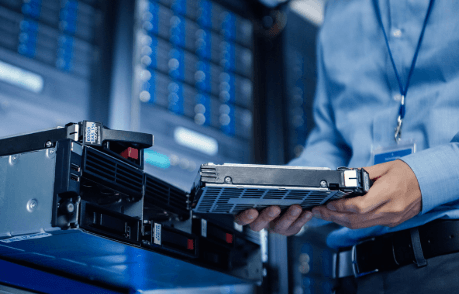
Enterprise computing is undergoing a major transformation driven by artificial intelligence, data-intensive workloads, and the increasing demand for real-time digital services. Traditional server architectures, which were once sufficient for virtualization and standard enterprise applications, are now being pushed to their limits.
Modern workloads such as AI model training, high-frequency trading, edge analytics, and large-scale cloud applications require a new generation of infrastructure built for extreme performance, scalability, and energy efficiency.
This is where Enterprise Server Solutions are evolving into highly optimized, heterogeneous systems powered by advanced CPUs, GPUs, memory architectures, and next-generation connectivity standards.
Organizations are no longer just purchasing servers. They are investing in full-stack computer ecosystems designed for future-ready performance. This article explores the key technological shifts shaping the future of enterprise servers and how they will redefine data center architecture over the next decade.
The Shift Toward Next-Generation Server Technology
The modern data center is no longer defined by raw compute alone. Instead, it is evolving into a highly distributed, intelligent system capable of handling AI workloads, real-time analytics, and hybrid cloud operations.
Key Drivers of Change
Several forces are accelerating the evolution of Enterprise Server Solutions:
- Explosion of AI and machine learning workloads
- Growth of hyperscale cloud computing
- Demand for real-time data processing
- Rise of edge computing environments
- Increasing energy efficiency requirements
These factors are driving a transition from traditional homogeneous server systems to highly specialized, modular, and workload-optimized architectures.
Next-Gen Chipsets and CPU Architectures
At the heart of modern server evolution lies the rapid advancement of CPU technologies. Both Intel and AMD are pushing toward architectures that prioritize performance density, energy efficiency, and AI acceleration.
Modern CPU Trends
Next-generation server processors are focusing on:
- Increased core counts for parallel processing
- Hybrid architectures combining performance and efficiency cores
- Integrated AI acceleration capabilities
- Improved memory bandwidth and cache hierarchies
These innovations are essential for supporting modern high-performance computing servers that must handle complex workloads such as simulation modeling, virtualization, and AI inference.
Heterogeneous Computing
One of the most significant trends is the rise of heterogeneous computing, where CPUs work alongside GPUs, TPUs, and specialized accelerators.
This allows enterprises to:
- Optimize workloads based on compute type
- Improve efficiency for AI-driven applications
- Reduce overall infrastructure costs
PCIe 6.0: The Future of Server Connectivity
Connectivity is a critical factor in server performance. As workloads become more data-intensive, the need for faster interconnects has become essential.
What PCIe 6.0 Brings to Enterprise Servers
PCIe 6.0 represents a major leap forward in server communication technology:
- Doubled bandwidth compared to PCIe 5.0
- Lower latency for real-time data transfer
- Improved efficiency for GPU and storage communication
- Enhanced scalability for AI and HPC workloads
Impact on AI and Data Centers
PCIe 6.0 will significantly impact:
- GPU acceleration performance
- High-speed NVMe storage systems
- Networking throughput in distributed environments
For AI servers, this means faster model training and more efficient inference pipelines.
Transition from DDR5 to DDR6 Memory
Memory technology plays a crucial role in server performance, especially in data-heavy workloads such as AI training and virtualization.
DDR5: Current Standard
DDR5 has already improved:
- Bandwidth over DDR4
- Power efficiency
- Data transfer rates
DDR6: The Next Leap
DDR6 is expected to deliver:
- Significantly higher memory speeds
- Increased channel efficiency
- Lower latency memory access
- Improved scalability for multi-core processors
Why This Matters
For Enterprise Server Solutions, memory speed directly impacts:
- AI model training performance
- Database processing speed
- Virtual machine density
- Real-time analytics capability
As datasets grow larger, memory bandwidth becomes a critical bottleneck that DDR6 is designed to solve.
Next-Generation Storage: The Evolution of NVMe and SSD Technology
Storage is another key pillar of modern server infrastructure. Traditional storage systems are no longer sufficient for real-time workloads.
NVMe Evolution
NVMe technology continues to evolve with:
- Faster PCIe integration
- Improved parallel processing capabilities
- Lower latency access to data
- Higher input/output operations per second (IOPS)
Future SSD Technologies
Next-generation SSDs will focus on:
- Higher endurance for continuous workloads
- Ultra-fast read/write speeds
- Increased storage density
- Better energy efficiency
Role in Enterprise Servers
These advancements are critical for:
- AI training datasets
- Cloud-native applications
- Big data analytics
- Real-time transaction processing
Modern Enterprise Server Solutions depend heavily on storage systems that can keep up with compute acceleration.
See also: The Evolution of Health Information Technology
AI and High-Performance Computing (HPC) Infrastructure
Artificial intelligence is one of the biggest drivers of server innovation today.
Growing Demand for AI Servers
Organizations are rapidly adopting AI servers to support:
- Large language model training
- Predictive analytics
- Computer vision systems
- Autonomous decision-making platforms
GPU Acceleration in Enterprise Servers
GPUs have become essential for:
- Parallel computation tasks
- Deep learning model training
- Scientific simulations
Edge and Hybrid Cloud Environments
Modern server infrastructure must support:
- Distributed edge computing nodes
- Hybrid cloud deployments
- Real-time data processing at scale
This shift is redefining how enterprise infrastructure is designed and deployed.
Current Enterprise Server Solutions and Infrastructure Readiness
While future technologies are shaping the roadmap, enterprises still require robust and scalable systems today.
Organizations looking for reliable infrastructure can explore advanced Enterprise Server Solutions that bridge current performance needs with future scalability requirements
These solutions are designed to support:
- Virtualization environments
- AI and machine learning workloads
- Cloud-native applications
- Enterprise database systems
Why Infrastructure Readiness Matters
Businesses cannot wait for future technologies alone. They need:
- Scalable server architectures
- Modular infrastructure design
- Compatibility with emerging technologies
- Strong lifecycle management
This ensures long-term investment protection while enabling gradual adoption of next-gen technologies.
Sustainability and Energy Efficiency in Modern Servers
As server performance increases, so does power consumption. This has made energy efficiency a top priority for data center operators.
Power-Efficient Server Design
Modern servers are focusing on:
- Lower watt-per-compute ratios
- Dynamic power scaling
- Intelligent workload distribution
Cooling Innovations
Cooling is one of the biggest challenges in high-density environments.
Emerging solutions include:
- Liquid cooling systems
- Immersion cooling technologies
- Advanced airflow optimization
Green Data Centers
Enterprises are also investing in:
- Renewable energy integration
- Carbon-neutral data center initiatives
- Energy-efficient hardware procurement
Sustainability is now a core requirement in Enterprise Server Solutions, not just an optional feature.
The Future of Enterprise Server Infrastructure
The future of server technology is being shaped by convergence across compute, memory, storage, and connectivity.
Key Future Trends
- Fully AI-optimized server architectures
- Deep integration of CPU, GPU, and accelerator workloads
- PCIe 6.0 and beyond connectivity standards
- DDR6 and next-gen memory systems
- AI-driven autonomous data centers
Toward Intelligent Infrastructure
Future servers will not just execute workloads. They will:
- Self-optimize performance
- Predict system failures
- Dynamically allocate resources
- Adapt to workload patterns in real time
This represents a shift from static infrastructure to intelligent computing ecosystems.
Conclusion Building the Future with Enterprise Server Solutions
The evolution of enterprise computing is accelerating at an unprecedented pace. From next-generation CPU architectures and PCIe 6.0 connectivity to DDR6 memory and advanced storage systems, every layer of server infrastructure is being redefined.
At the center of this transformation are Enterprise Server Solutions, which are evolving into highly intelligent, scalable, and energy-efficient systems designed for the demands of AI, HPC, and cloud-native workloads.
As organizations prepare for the future, investing in scalable and forward-compatible infrastructure is no longer optional. It is a strategic necessity for maintaining competitiveness in a data-driven world.
Providers like Saitech Tech are positioned within this evolving ecosystem, offering access to modern server infrastructures designed for both current performance demands and future technological shifts.
For more information on optimizing your AI infrastructure with enterprise server solutions and expert deployment services, contact us.