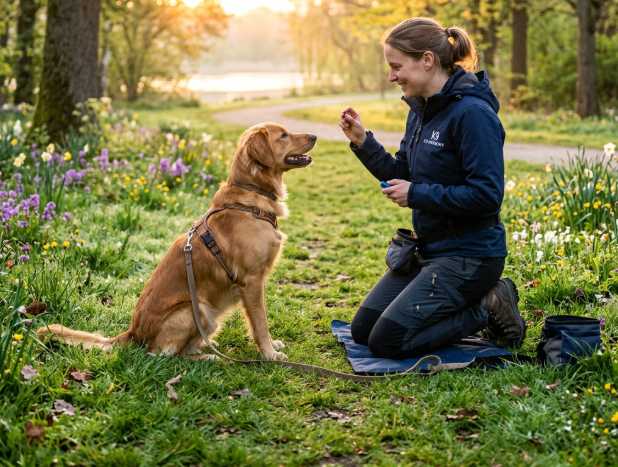
Does your dog lunge at strangers on walks? Bark relentlessly at the mailman? Refuse to come when called? These aren’t signs of a “bad” dog—they’re signs of a dog who hasn’t yet learned what’s expected of them. And that’s exactly where behavior modification training comes in.
Dog behavior modification training is one of the most effective ways to address problem behaviors at their root cause, rather than simply masking them. Unlike basic obedience training, which focuses on teaching commands, behavior modification digs deeper—identifying why a dog is behaving a certain way and reshaping those patterns over time. It’s a process grounded in science, patience, and a genuine understanding of how dogs think and learn.
If you’ve been living with a dog whose behavior feels unmanageable, you’re not alone. Millions of pet owners struggle with the same challenges. The good news? These behaviors can change.
Why Some Dogs Develop Problem Behaviors
Before diving into what behavior modification training can do, it helps to understand why dogs develop unwanted behaviors in the first place.
Dogs aren’t acting out of spite or stubbornness—though it can certainly feel that way. Problem behaviors typically stem from a few key sources:
- Fear and anxiety: A dog that snaps when touched may be responding out of fear, not aggression.
- Lack of socialization: Dogs not exposed to a variety of people, animals, and environments early in life may react poorly to unfamiliar situations.
- Past trauma or negative experiences: Rescue dogs, in particular, may carry behavioral baggage from previous environments.
- Inconsistent reinforcement: When a behavior sometimes gets rewarded and sometimes gets punished, dogs become confused—and confusion often leads to more problematic behavior.
- Underlying medical issues: Pain or illness can also manifest as behavioral changes, which is why a vet check is always a good first step.
Understanding the “why” behind a behavior is the cornerstone of effective behavior modification.
See also: Online Counsellor Hong Kong: Accessible Mental Health Support for Modern Life
What Does Dog Behavior Modification Training Actually Involve?
Dog Behavior Modification training is a highly personalized service that helps dogs replace unwanted behaviors with calm, appropriate responses through structured, science-backed techniques—giving both dogs and their owners the tools to build a more trusting, stress-free relationship at home and in the world.
The process typically begins with a thorough behavioral assessment. A professional trainer observes and evaluates the dog’s responses in different situations, identifying triggers, patterns, and the intensity of the behavior. From there, a customized training plan is developed.
Common techniques used in behavior modification include:
Desensitization
This involves gradually exposing a dog to the thing that triggers a negative reaction—at a distance or intensity that doesn’t provoke a response. Over time, the threshold is slowly reduced. A dog that reacts aggressively to other dogs on leash, for example, might begin training by simply being in a large open space where other dogs are barely visible.
Counter-Conditioning
Often used alongside desensitization, counter-conditioning pairs the trigger with something the dog loves—typically high-value treats. The goal is to change the dog’s emotional response to the trigger from negative to positive. With enough repetition, seeing another dog stops being something scary and starts becoming a signal that good things are coming.
Differential Reinforcement
Rather than punishing unwanted behavior, differential reinforcement rewards an alternative, incompatible behavior. If a dog jumps on guests, for example, they’re rewarded for keeping all four paws on the floor. The unwanted behavior becomes unnecessary because the dog learns a better way to get what they want.
These techniques require precision, timing, and consistency—which is why working with a qualified professional makes such a significant difference.
The Behaviors That Respond Well to Modification Training
One of the most encouraging aspects of behavior modification training is the wide range of issues it can address. Pet owners often seek this service for:
- Leash reactivity – lunging, barking, or pulling toward other dogs or people
- Fear-based aggression – snapping, growling, or biting in response to perceived threats
- Separation anxiety – destructive behavior, excessive vocalization, or elimination when left alone
- Resource guarding – growling or snapping over food, toys, or spaces
- Excessive barking – particularly when triggered by specific stimuli
- Fearfulness and phobias – thunder, fireworks, car rides, strangers
No two dogs are the same, and neither are their behavioral challenges. That’s why individualized assessment is so essential to the process.
What Progress Actually Looks Like
Managing expectations is important. Behavior modification is not an overnight fix—and anyone who promises dramatic results in a single session is overselling. Significant, lasting behavioral change takes time, repetition, and commitment from the owner as well as the dog.
That said, most pet owners begin noticing meaningful improvements within a few weeks of consistent training. A dog that once erupted at every passing cyclist might start to glance up, then look back at their owner for a treat. A dog that shut down around strangers might begin to approach them with cautious curiosity rather than fear.
These small moments of progress add up. And with continued reinforcement, the new behaviors become the dog’s default—not something that requires constant management.
The Role You Play as a Dog Owner
Professional training is only part of the equation. The work that happens between sessions—at home, on walks, during everyday interactions—determines how quickly and thoroughly change takes root.
That means following through on the techniques your trainer teaches. It means staying calm when your dog reacts, because dogs are remarkably attuned to human emotion. It means being consistent, even when it’s inconvenient. And it means celebrating progress, no matter how small.
Owners who actively participate in the training process consistently see better outcomes than those who leave everything to the professional. This is a partnership—between you, your dog, and your trainer.
Giving Your Dog a Better Life Starts Here
Problem behaviors don’t have to define your dog’s life, or yours. With the right support, even dogs with deeply ingrained behavioral challenges can make remarkable progress.
A skilled local dog trainer specializes in exactly this kind of work, combining evidence-based techniques with genuine care for both dogs and their owners, creating training plans that are realistic, compassionate, and effective.
Your dog deserves to feel safe, understood, and confident. And you deserve to enjoy life with them. Behavior modification training makes both possible, one session, one breakthrough, one small victory at a time.