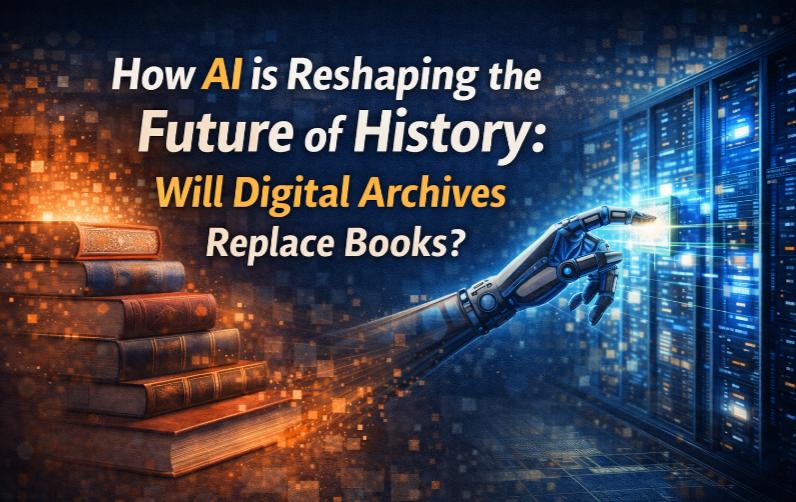
The smell of old parchment, the weight of a leather-bound tome, and the quiet rustle of turning pages have defined our relationship with the past for centuries. However, as we move further into 2026, the silent corridors of traditional libraries are being met with the hum of high-speed servers. Artificial Intelligence is no longer just a tool for Silicon Valley; it has become the new archaeologist of the digital age. We are witnessing a monumental shift where algorithms can now read ancient scripts faster than any human scholar, raising a provocative question: Is the physical book becoming a relic of the past, or is AI simply giving it a second life?
The transition from physical shelves to cloud-based storage is not just about saving space; it is about accessibility and the democratization of knowledge. For a modern student or researcher, the ability to scan millions of documents in seconds is a game-changer. When the sheer volume of data becomes overwhelming, many turn to professional Assignment Help from experts like myassignmenthelp to synthesize these massive digital archives into coherent essays or theses. This synergy between human expertise and digital speed is defining how we interact with history today, ensuring that the stories of our ancestors are not lost in the transition to binary code but are instead made more visible to a global audience.
1. The Rise of the “Digital Time Machine”
In the past, a historian might spend a lifetime cataloging a single dynasty’s records. Today, Machine Learning models are trained to recognize patterns in faded ink and broken stone tablets. Projects are already underway to digitize the entirety of the Vatican Apostolic Archive and the British Library’s rarest collections. These “Digital Time Machines” allow us to search for specific names, dates, or even emotional tones across centuries of text.
The Power of HTR (Handwritten Text Recognition)
Standard OCR (Optical Character Recognition) has worked for printed books for decades. But history is written in cursive, in shorthand, and in languages that are now extinct. AI models in 2026 use “Deep Learning” to understand the stroke of a pen rather than just the shape of a letter. This allows for the transcription of medieval manuscripts with over 95% accuracy—a feat that previously required a PhD and decades of patience.
2. Why Books Still Hold the “Soul” of History
Despite the digital surge, the death of the book has been prematurely predicted many times. There is a “tactile intelligence” in physical archives that AI cannot replicate. A book is more than its text; it is the watermarks on the paper, the marginalia scribbled by a reader in 1740, and the physical DNA left behind on its covers.
The Comparison: Digital vs. Physical
To understand the future, we must look at where each medium excels. The following table highlights the shifting roles of libraries and digital databases in 2026.
| Feature | Physical Books & Archives | AI-Driven Digital Archives |
| Longevity | 500+ years (if stored correctly) | Dependent on software/hardware updates |
| Accessibility | Limited to physical location | Global, 24/7 access |
| Searchability | Manual indexing and browsing | Semantic search (concept-based) |
| Sensory Experience | Tactile, smell, historical “weight” | Screen-based, visual/auditory only |
| Preservation | Vulnerable to fire, flood, decay | Immune to physical decay; prone to data loss |
3. The Ethics of AI-Generated History
As we rely more on AI to interpret the past, we face a new danger: Algorithmic Bias. AI models are trained on existing data, and if that data is biased toward one culture or perspective, the AI will repeat those biases. For instance, if most digitized records are in English, the history of non-Western civilizations—like the rich oral traditions of South Asia or Africa—might be sidelined.
The “Deepfake” History Risk
In 2026, the rise of generative AI means that “forging” a historical document is easier than ever. We now need “Historical Verifiers”—AI models designed to detect other AI-generated content. This creates a cat-and-mouse game where the authenticity of a 19th-century letter might be called into question because an algorithm suggests its syntax is “too perfect.”
4. The Shift in Education: Why AI Skills Matter for Gen Z
As the job market and academic landscape evolve, the ability to navigate these complex digital tools is becoming mandatory. This is exactly Why AI Skills Matter for Gen Z; it is no longer enough to just know facts; you must know how to audit the algorithms that present those facts to you. Students today are moving away from being “consumers” of history to being “curators.”
The Evolution of the Research Paper
In 2026, a 12th-grade history project looks very different from one in 2016. A student might use an AI agent to crawl the digital archives of the National Archives, extract every mention of a specific trade route, and visualize it on a 3D map. But the “human element”—the ability to ask why these events happened—remains the most valuable skill.
5. The Hybrid Future: A Partnership, Not a Replacement
The future of history will not be an “either/or” scenario. We are entering an era of the Hybrid Archive. In this world, the physical book is kept as a sacred “master copy,” while the digital version serves as the “working copy” for the world to explore.
The Role of Libraries as “Experience Centers”
By 2026, physical libraries are transforming. They are no longer warehouses for books. Instead, they have become “Experience Centers.” You might visit a library to see the original Magna Carta, but you will use an Augmented Reality (AR) headset to see the “ghost” of the scribe who wrote it, explaining the context of each line.
6. Case Study: The Restoration of the “Lost” Scrolls
One of the most exciting breakthroughs in 2025-2026 was the use of X-ray phase-contrast tomography and AI to read the En-Gedi scrolls. These were charred lumps of carbonized parchment that could not be unrolled without crumbling. AI was able to virtually “unroll” the scrolls and read the ink hidden within the layers.
This proves that AI isn’t replacing the past; it is recovering parts of it that we thought were lost forever. This “non-invasive archaeology” is the gold standard for preservation in the 2020s.
7. The Global Impact: Bridging the Language Gap
For sites like STVUrdu, the linguistic capabilities of AI are particularly relevant. Historically, much of the world’s scholarly research has been locked behind a language barrier. AI-powered real-time translation is now allowing Urdu-speaking researchers to access German, French, or Japanese archives with near-perfect nuance.
This creates a “Global History” where a student in Lahore can collaborate with a researcher in Paris to compare the colonial records of the 19th century. This cross-pollination of ideas is the true legacy of the digital archive revolution.
8. Sustainability: The Hidden Cost of Digital
While we think of digital as “green” because it saves trees, the reality is more complex. The massive server farms required to host the world’s digital archives consume incredible amounts of energy. In 2026, “Sustainable Archiving” has become a major field of study.
- Physical Books: Zero energy to maintain once printed.
- Digital Archives: Continuous cooling and electricity needed for 24/7 access.
The solution? Cold storage. Historical data that isn’t accessed frequently is being moved to energy-efficient “slow drives,” while only the most searched history remains on “hot” servers.
9. Final Thoughts: The Human Element
At the end of the day, history is a human story. While AI can process data, it cannot feel the weight of a tragedy or the triumph of a discovery. We use digital archives to gather the pieces, but we still need the human mind to put them together in a way that makes sense of our world. Books may change their form, and archives may move to the cloud, but our hunger to understand where we came from remains unchanged.
The future of history is not in the hands of the machines, but in the partnership between the machine’s speed and the human’s heart. Whether you are a student using Assignment Help to navigate your first major thesis or a seasoned historian uncovering a lost empire, the tools have changed, but the mission is the same: to keep the past alive.
Frequently Asked Questions
1. Will digital files eventually replace all physical library collections?
While digitization improves global access, physical books remain essential for long-term preservation. Digital formats require constant software updates and energy to remain readable, whereas physical records provide a stable, “offline” backup that can last for centuries without technological intervention.
2. How does artificial intelligence help in reading damaged historical documents?
Advanced algorithms use specialized scanning techniques to identify faint ink traces and patterns that are invisible to the human eye. This technology can virtually “unroll” fragile, charred, or stuck pages, allowing researchers to recover text from artifacts that are too delicate to handle physically.
3. Can we trust AI to interpret history accurately?
AI is a powerful tool for processing data, but it can reflect the biases of the records it was trained on. Human oversight is crucial to ensure that diverse cultural perspectives are maintained and to verify that the information generated by the software is historically authentic.
4. What are the environmental impacts of storing history online?
Digital archives require massive server farms that consume significant amounts of electricity and water for cooling. To address this, many institutions are adopting “green” storage solutions, focusing on energy-efficient data centers to balance the benefits of instant access with environmental responsibility.
About The Author:
Min Seow is a dedicated education consultant and content strategist who specializes in bridging the gap between traditional learning and modern technology. Representing myassignmenthelp, Min focuses on providing students with the resources and clarity needed to navigate complex academic landscapes with confidence.