When it comes to cooling an entire home, office, school, or multi-room commercial space efficiently and economically, few solutions match the capability of a well-designed ducted evaporative air cooler. Unlike standalone portable units that cool only the immediate area around them, a ducted system distributes freshly cooled air through a network of ducts and vents to every room in the building — delivering consistent, whole-space comfort from a single centrally installed unit.
For property owners who want the comfort of whole-building cooling without the enormous running costs associated with traditional refrigerant air conditioning, a ducted evaporative air cooler represents one of the most compelling investments available. Understanding how these systems work, what makes them effective, and what to look for in a quality unit will help you make a confident and well-informed decision.
How a Ducted Evaporative Air Cooler Works
A ducted evaporative air cooler operates on the principle of evaporative cooling — one of nature’s most efficient and elegant heat transfer mechanisms. At the heart of the unit are specialised cooling pads, typically made from high-porosity cellulose or polymer media, through which water is continuously circulated. A powerful fan draws warm outside air through these saturated pads. As the air passes through, the water evaporates and absorbs heat from the air, causing a significant and immediate temperature drop. This cooled, humidified air is then distributed through the duct network to every room in the building.
The critical distinction between a ducted evaporative air cooler and a conventional air conditioning system is that the evaporative cooler does not recirculate the same air. It continuously draws in fresh outside air, cools it, and delivers it into the building — simultaneously pushing stale, warm indoor air out through open windows or vents. This constant air exchange delivers meaningfully superior indoor air quality alongside cooling performance.
The energy requirements of this process are dramatically lower than those of refrigerant-based cooling. A ducted evaporative air cooler uses a fan motor and a small water pump — both of modest electrical demand — compared to the high-energy compressors required by conventional air conditioning. Running costs are typically 70 to 90 percent lower, which over the lifetime of the system represents a very significant financial advantage.
Design Features That Define High-Performance Ducted Systems
Not all ducted evaporative coolers are engineered to the same standard, and the differences in design quality have a direct impact on cooling performance, durability, and long-term reliability. Several design features distinguish high-performance systems from commodity alternatives.
Cooling pad design and media quality are fundamental. The pad is where all the heat transfer occurs, and the surface area, porosity, water distribution uniformity, and material durability of the pad determine how effectively the unit can drop air temperature. Premium systems use high-grade cooling media engineered for maximum evaporation efficiency and long service life. A three-side pad design, where cooling media wraps around three faces of the unit, dramatically increases the effective surface area and cooling output compared to single or dual-side configurations.
Fan and blower design directly affects airflow volume and distribution efficiency. Centrifugal blowers, which generate high static pressure and maintain strong airflow even against the resistance of a duct network, are significantly more effective for ducted applications than axial fans. The quality of the fan motor — its power rating, bearing design, and thermal management — determines reliability over years of continuous operation.
Cabinet construction matters enormously for longevity. Evaporative coolers operate in wet environments, and units built with galvanised steel or rust-proof metal bodies will outlast those built from lesser materials by many years. Water management systems — including corrosion-resistant water tanks, reliable float valves, and effective drainage mechanisms — prevent the scale buildup and water quality issues that can degrade cooling performance over time.
Ducted Evaporative Cooler Installation and Duct Design
The performance of a ducted evaporative air cooler is heavily influenced by the quality of the duct network design and installation. A well-designed duct system ensures that cooled air is delivered to every room at the right velocity and volume, without significant pressure losses or uneven distribution. Poor duct design — with excessive bends, incorrect sizing, or inadequate sealing — compromises performance regardless of how capable the central unit is.
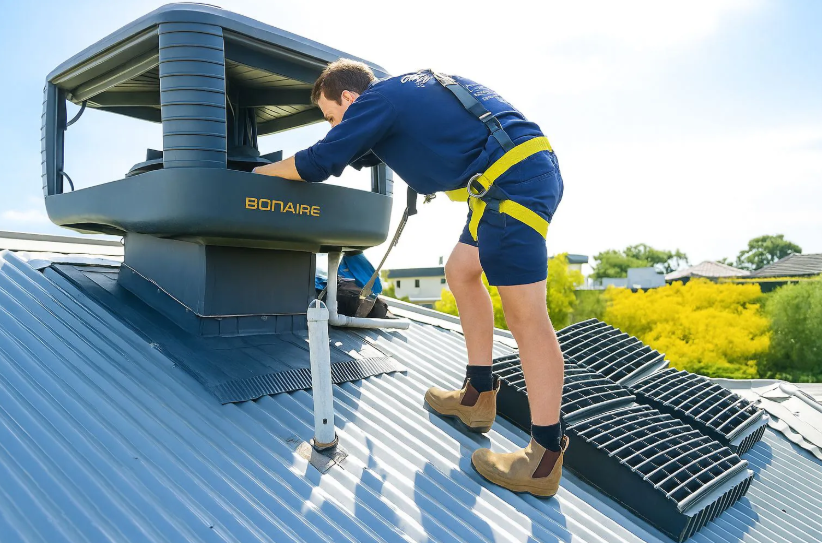
The positioning of the cooler itself should account for access to fresh outside air, proximity to the duct distribution centre of the building, and maintenance accessibility for filter cleaning and pad replacement. Roof-mounted installations are common for residential applications, while wall or ground-mounted configurations suit different commercial and industrial scenarios.
Professional installation by experienced technicians ensures the system is set up correctly from the outset — properly connected to the duct network, correctly configured for water supply, and calibrated for optimal performance in the specific building environment.
Maintenance Requirements for Ducted Evaporative Systems
A ducted evaporative air cooler requires modest but regular maintenance to sustain performance over the long term. Key maintenance tasks include periodic cleaning or replacement of cooling pads, flushing and cleaning of the water tank to prevent mineral scale accumulation, inspection and cleaning of the distribution ducts, and seasonal winterisation in climates where the system is not used year-round. Regular maintenance not only sustains cooling performance but also extends the operational lifespan of the system significantly.
See also: Trusted Custom Home Builder Brisbane for Quality New Homes
The Right Ducted Cooler for Your Application
Selecting the right ducted evaporative air cooler for a specific application requires matching the unit’s airflow capacity to the volume and heat load of the space being cooled. A qualified cooling engineer can perform the calculations needed to specify the correct unit size and duct configuration for optimal whole-building performance.
Arctic (a Pahwa Group company) manufactures ducted evaporative coolers engineered to the highest performance standards, featuring its unique three-side pad design, centrifugal blowers, and industry-leading rust-proof metal construction — all available through yesarctic.com. Request a consultation today to find the ideal ducted system for your home or commercial space.